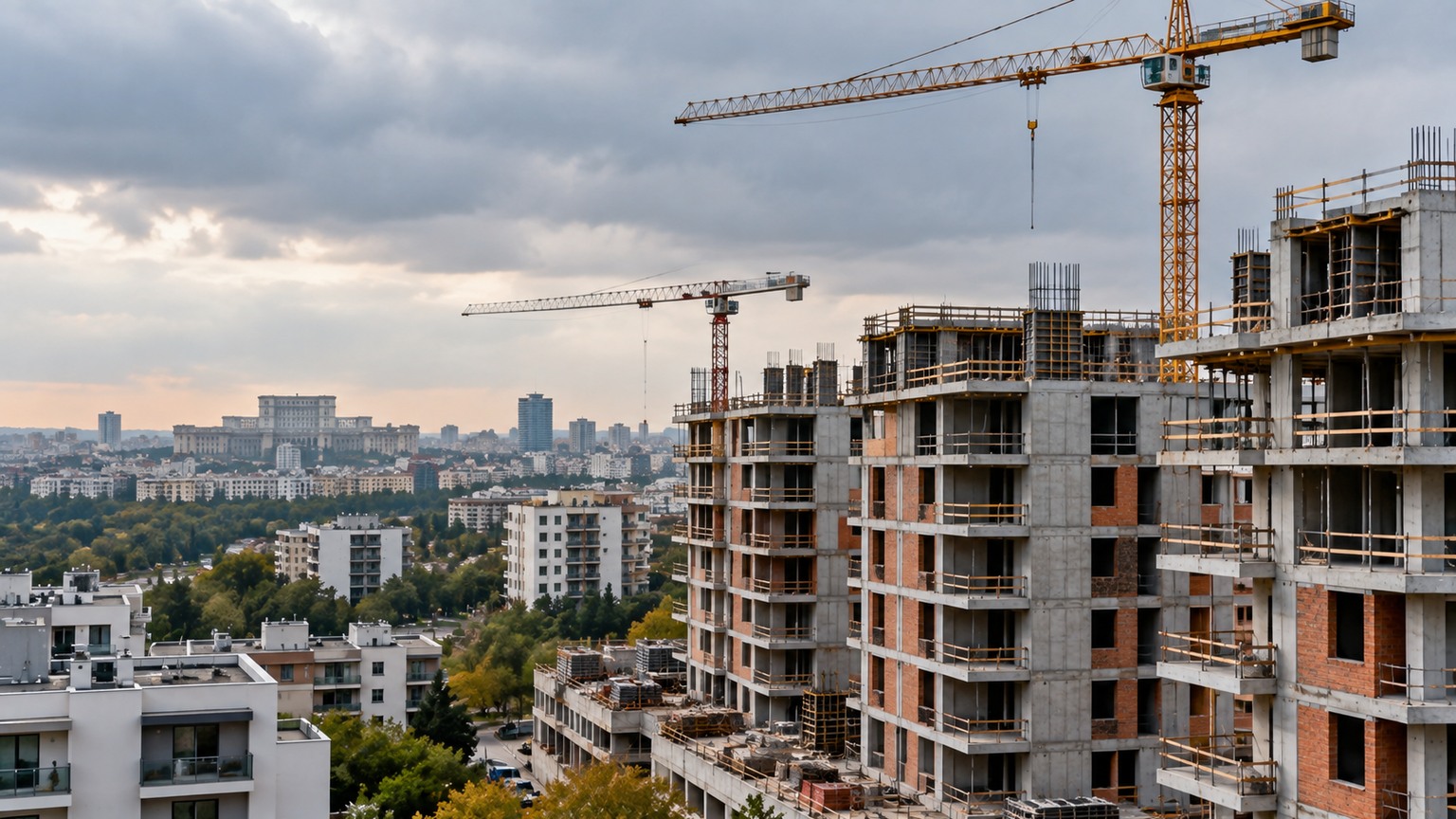
Romania’s residential construction market is sending two different signals. Work on projects already under construction has remained relatively active, but the value of newly started multi-unit housing projects fell by about 30% year on year in the first half of 2026, according to Buildecon’s EBI project-start indicator.
That distinction matters for buyers and developers. Construction-output statistics describe work happening now; project-start data give an earlier view of what may reach the market later. A sustained drop in starts can translate into a thinner pipeline of apartments over the next several years, even if cranes remain visible today.
Buildecon says its Project-Start indicator is built from project-level data compiled with ELTINGA and iBuild because Romania does not have an official construction-start indicator of the same kind. Its September update put first-half multi-unit housing starts roughly 30% below the same period of 2025. Business Forum, citing the EBI Construction Activity Report Romania Q2 2026, reported a 31% decline and linked the slowdown to expensive financing, softer demand, inflation and pressure on development economics.
The weakness was not limited to housing. The same report put newly started non-residential projects 17% lower year on year and infrastructure starts 14% lower. That makes the residential decline the sharpest of the three broad construction segments.
For the housing market, the immediate implication is not that supply is collapsing today. It is that the next wave of completions may become less generous if the fall in new starts persists. That is relevant because Romania has already been combining weaker transaction volumes with resilient asking prices and constrained supply in several cities.
Estate Briefing’s recent analysis of Romania’s housing market found apartment transactions down around 9% nationally in the first half of 2026 while asking prices were still rising. A separate city-level review showed that Bucharest, Cluj-Napoca, Iași and Timișoara are moving at very different speeds. The new project-start data add another layer: future supply conditions may also diverge from the level of construction activity visible today.
Sources and limits
Buildecon / EBI ↗
Institutional research · 2026-09-09
Business Forum ↗
Business media · 2026-09-16
This is research, not investment, tax or legal advice. Definitions and observation dates remain attached to every claim.