
Romania recorded the European Union’s largest annual rise in construction production in August 2026. Eurostat’s release of 20 October puts output 39.0% above the level of August 2025, compared with a 2.6% increase for the EU as a whole. Romania also posted a 7.2% seasonally adjusted monthly rise. These are unusually strong activity figures, but they answer a different question from how many apartments were sold or handed over.
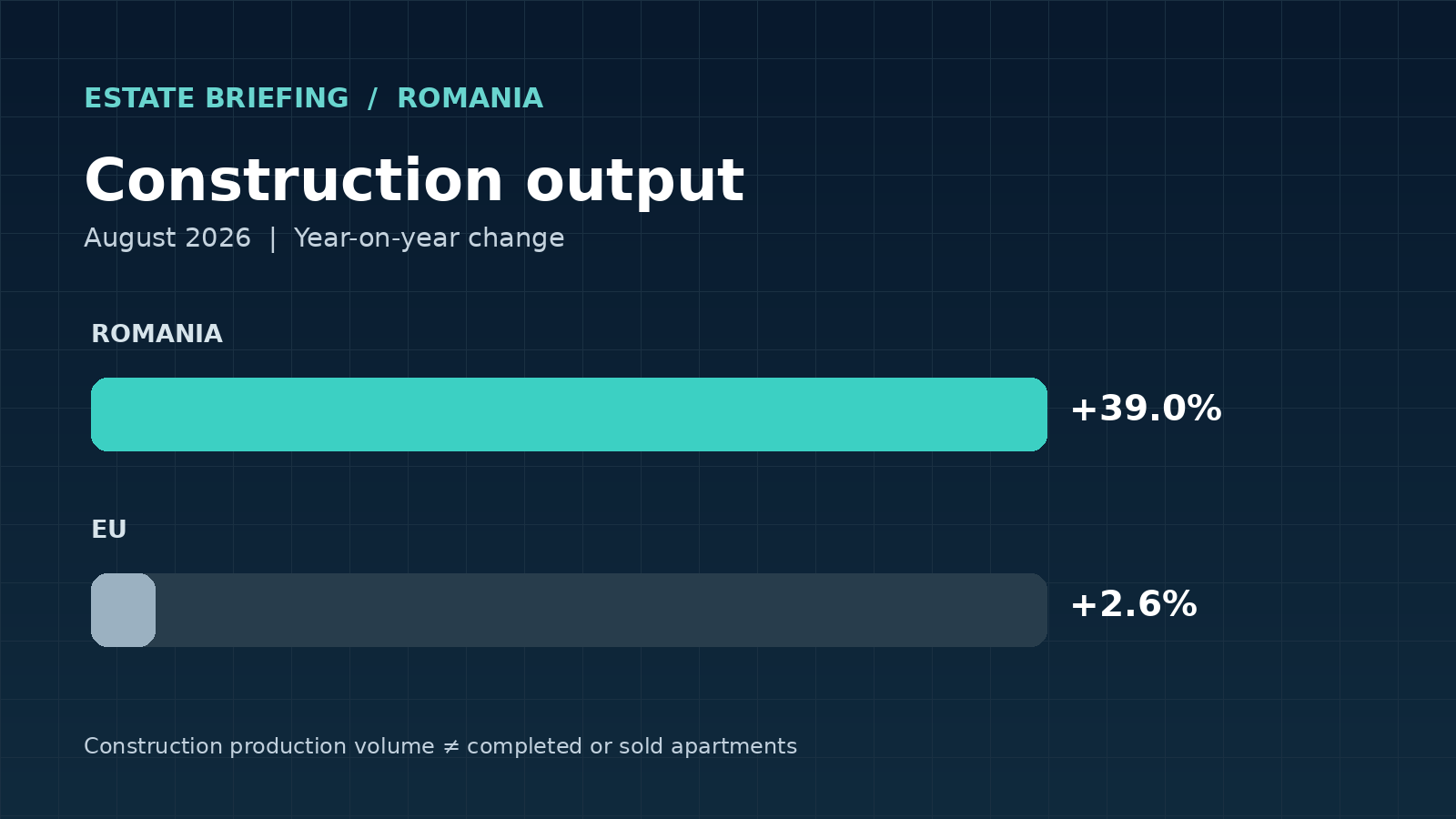
Construction production is an output-volume indicator. It captures work taking place across the sector, including buildings, civil engineering and specialised activities. A higher index can reflect faster progress on projects already under way, infrastructure spending, repair work or changes in the comparison base. It does not tell buyers whether a specific residential scheme has obtained occupancy permission, or whether new units have found purchasers.
The distinction is visible in the EU breakdown. While total EU construction output was up 2.6% year on year, the construction-of-buildings component was down 4.1%. Different components and countries can move in opposite directions. Romania’s headline therefore should not be transferred automatically to the national new-home market, much less to Bucharest or Cluj-Napoca prices.
For developers and investors, the next checks are housing completions, permits, residential starts, mortgage conditions and local transaction data. The August reading is evidence of a construction-activity rebound, not a forecast of house-price growth or proof that a particular project will finish on time. Eurostat’s next construction release is scheduled for 19 November 2026.
Sources and limits

Eurostat ↗
Official statistics · 2026-10-20
This is research, not investment, tax or legal advice. Definitions and observation dates remain attached to every claim.
 Poland · Poland unveils public housing investment map as ministry reports PLN 7.1bn in support
 Romania · Romania’s September mortgage lending reaches a record
 Greece · Intrum estimate puts nearly 15,000 Greek homes with banks and loan servicers