
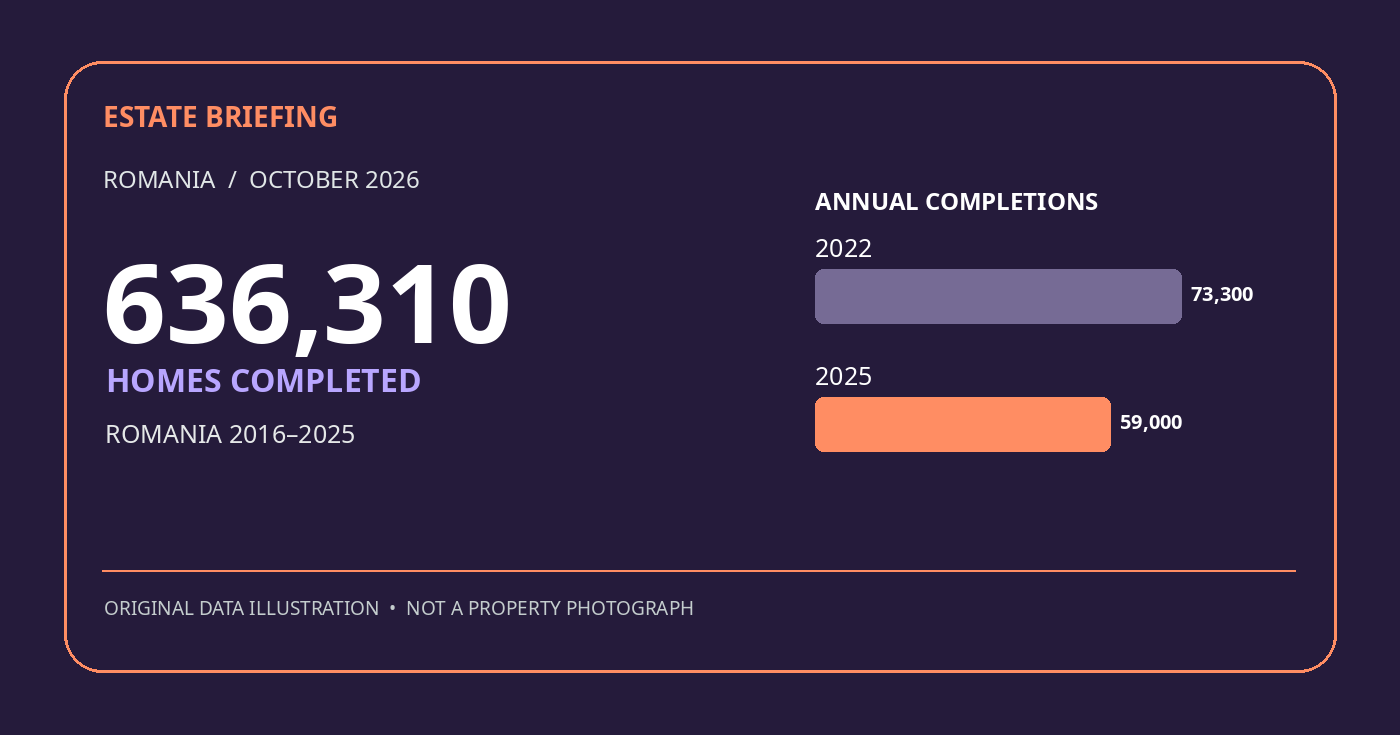
Romania completed 636,310 homes from 2016 through 2025, according to research published on 13 October by Cushman & Wakefield Echinox using National Institute of Statistics data. That equals 32.9 new homes per 1,000 inhabitants over the decade, close to Germany's 33.6 and below Poland's 55.2. The figures measure completed housing units, not current homes offered for sale, construction permits or sales contracts. This distinction matters when assessing whether a market has too much available stock.
The annual pace has already eased. Completions peaked at about 73,300 in 2022, then declined to roughly 71,000 in 2023, 61,000 in 2024 and 59,000 in 2025. The latest figure is approximately 19.5% below the peak. Bucharest accounted for 93,850 completions during the decade, compared with 25,200 in Cluj-Napoca and 22,300 in Brașov. Adjusted for population, however, Brașov led the large cities surveyed with 94 completions per 1,000 residents, compared with 52.5 in Bucharest.
These comparisons point to a more selective development cycle, but they cannot by themselves identify an oversupplied neighbourhood. Ten-year construction intensity is a historical flow measure; it says nothing directly about vacancy, household formation, unsold inventory or local rents today. A buyer or developer should combine completions with recent transactions, affordability, infrastructure and project delivery schedules. The useful conclusion is not that all Romanian housing markets are cooling at the same speed, but that city-level conditions deserve separate analysis.
Sources and limits
Cushman & Wakefield Echinox ↗
Company research release · 2026-10-13
AGERPRES ↗
News agency verification · 2026-10-13
This is research, not investment, tax or legal advice. Definitions and observation dates remain attached to every claim.