
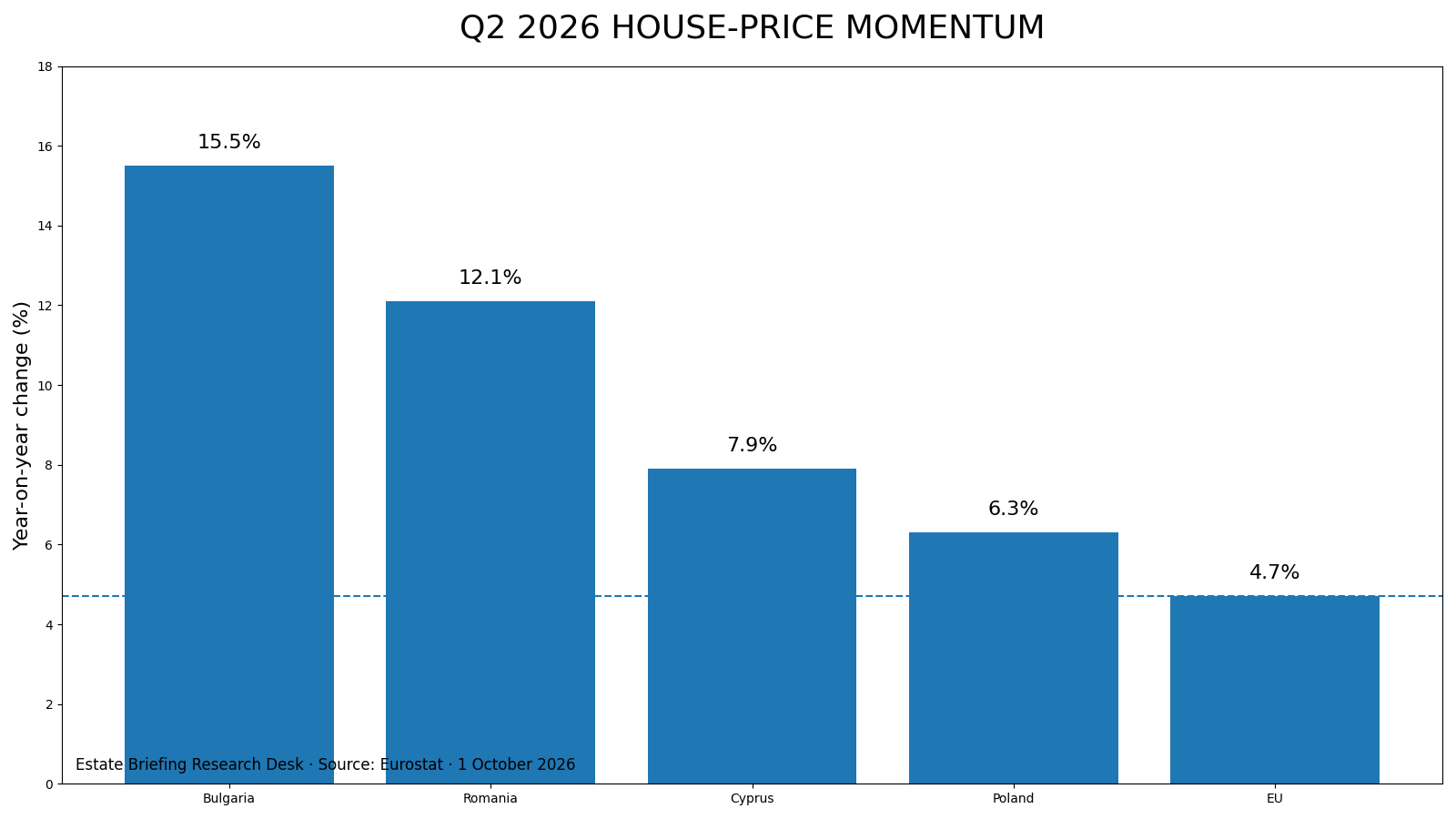
The clearest signal is not simply that prices rose in all four markets, but that the pace is separating. Bulgaria remained the fastest of the group and was second in the EU for annual house-price growth. Romania accelerated sharply: its annual rate reached 12.1%, while its 4.4% quarterly increase was among the highest in the Union. Cyprus also moved above the EU average, while Poland recorded a more moderate 6.3% annual increase.
For investors, the comparison is useful as a momentum indicator rather than a direct measure of returns. A fast-rising HPI does not by itself establish rental yield, liquidity or future appreciation, and it does not distinguish individual cities or projects. The harmonised series is valuable because Bulgaria, Romania, Poland and Cyprus are measured within the same Eurostat framework and the same Q2 2026 period.
Greece is not ranked in this table because Eurostat reports its transaction-based HPI as unavailable; Bank of Greece valuation-price data are used only to estimate European aggregates. Georgia is outside the EU HPI framework and is therefore excluded rather than mixed with a non-comparable national series. The result is a narrower but methodologically cleaner comparison: Bulgaria and Romania show the strongest current price momentum, with Cyprus and Poland still growing faster than the EU average.
Sources and limits

House prices up by 4.0% in the euro area ↗
official statistics release · 2026-10-01
This is research, not investment, tax or legal advice. Definitions and observation dates remain attached to every claim.