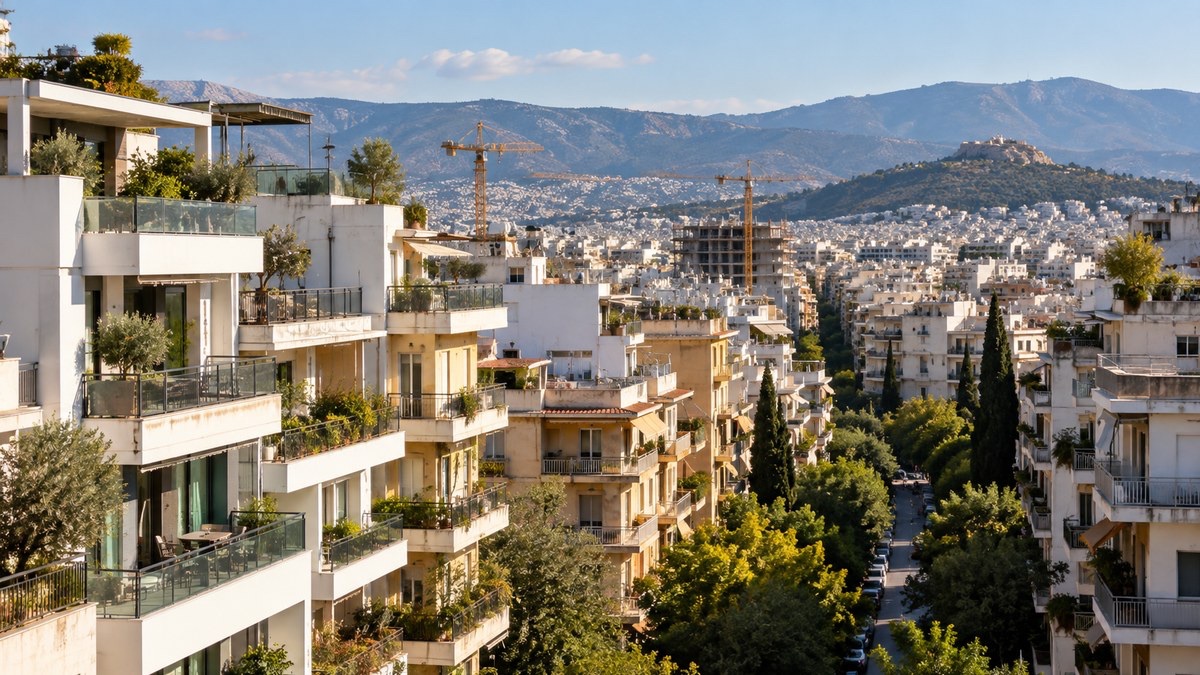
Greece is still getting more expensive for homebuyers, but the latest Bank of Greece update makes the change in pace difficult to miss. Apartment prices increased 5.7% year on year in the first quarter of 2026. That is still a strong nominal rise, but it is substantially slower than the 8.1% average increase recorded in 2025 and the 9.1% gain in 2024.
The slowdown is broad, not isolated
The deceleration appears across age categories and major cities. New apartments, defined by the central bank as properties up to five years old, rose 6.0% year on year. Older apartments increased 5.5%. Athens recorded a 5.2% increase, while Thessaloniki remained stronger at 6.4%.
Those figures come from the Bank of Greece residential property price indices, which are built from bank valuations rather than asking-price listings. The central bank had received 964,300 property valuations with reference periods through the end of March 2026. The measure therefore captures a different part of the market from portal asking prices and should not be mixed with them.
Slower prices, stronger investment
The most interesting part of the picture is that softer price growth is occurring alongside much stronger residential investment. The Bank of Greece reports that housing investment rose 15.0% year on year in Q1 2026 and reached 2.7% of GDP, using seasonally adjusted constant-price ELSTAT data.
That combination looks more like normalization than a broad market reversal. Prices are still advancing, capital is still moving into housing, and newer apartments continue to post slightly stronger appreciation than older stock. What has changed is the speed.
Athens is no longer the fastest part of the story
The geography also matters. Athens at 5.2% was below Thessaloniki at 6.4%, while the Bank of Greece reported 5.4% growth in other cities and 6.9% in other areas of the country. A national headline therefore hides a market that is no longer moving in lockstep.
That divergence may become more important as affordability constrains buyers differently by city and segment. It also makes it harder to treat a single national growth rate as a proxy for the investment case in a specific neighbourhood.
What the new supply can change
The next question is whether the jump in residential investment turns into completed housing in the segments where demand is strongest. If it does, additional supply could gradually reduce some price pressure. If investment remains concentrated in expensive new-build stock or high-demand locations, the national construction figure may do much less for affordability than the headline suggests.
For now, the evidence does not point to falling Greek home prices. It points to a market still appreciating, but at a clearly slower rate, while construction investment remains strong. That distinction matters for buyers and investors: the easy assumption of another year of near-double-digit national price growth is becoming harder to defend.
Data limitations
The Q1 2026 residential property price release reports price indices based on bank valuations, not average asking prices and not a simple mean of completed transaction prices. Residential investment is a national-accounts measure and cannot be translated directly into a number of homes entering the market. The indicators should therefore be read together, but not as interchangeable measures.
Sources and limits
Bank of Greece — Note on the Greek Economy 4 September 2026 ↗
Central bank research · 2026-09-04
Bank of Greece — Indices of residential property prices: Q1 2026 ↗
Official statistics · 2026-06-09
This is research, not investment, tax or legal advice. Definitions and observation dates remain attached to every claim.