
A rental apartment is not an interest-bearing account. homeradar.ge’s new Batumi rental analysis compares eight project scenarios and explicitly treats returns as modelled rather than guaranteed. The distinction matters because an advertised rental percentage often leaves out the weeks without guests and the expenses required to turn bookings into owner cash. Galt & Taggart’s city-level estimate, for example, fell from 8.8% in 2024 to 7.4% in 2025. That is a market indicator, not the post-tax profit of a particular furnished unit.
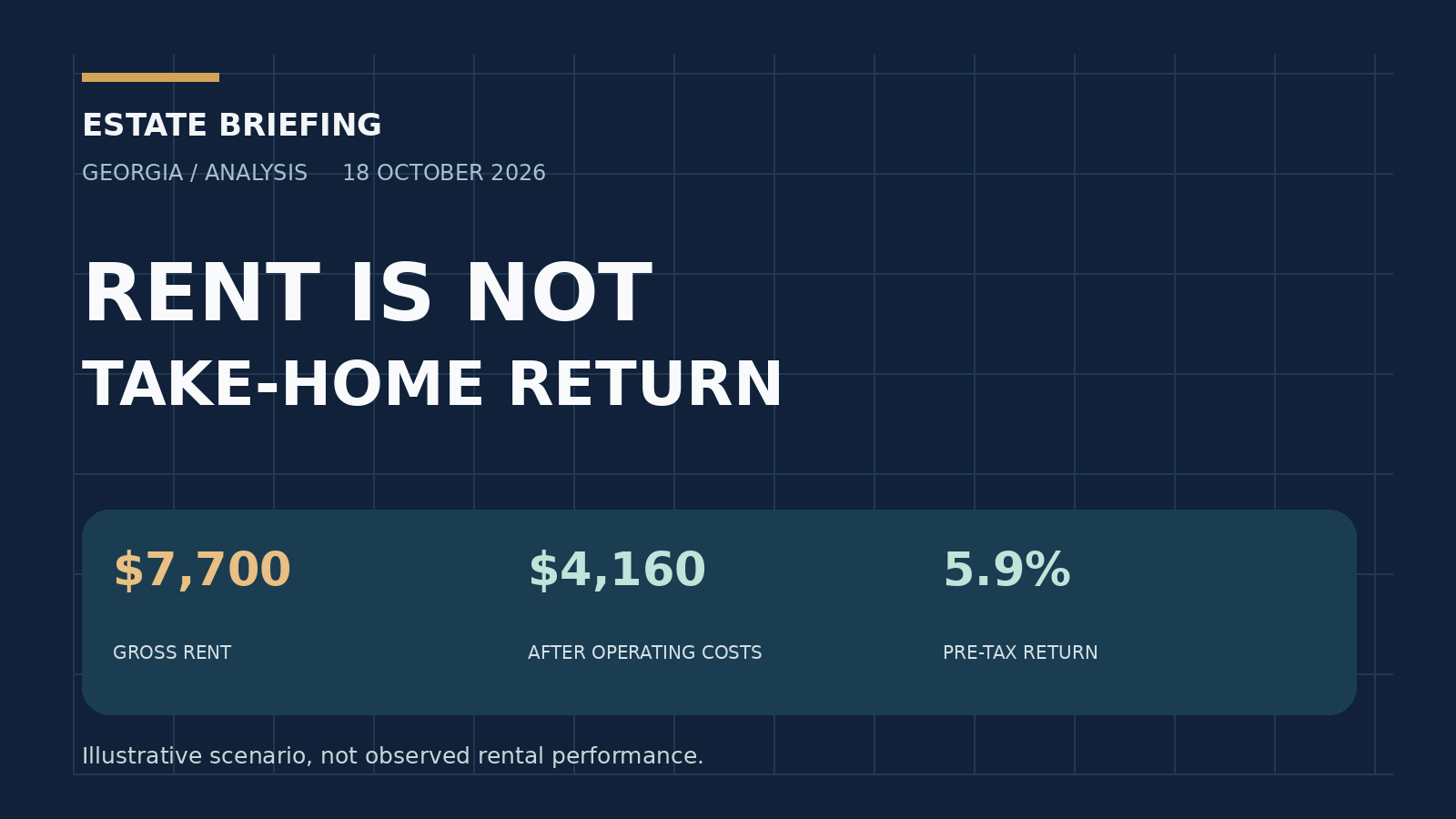
Consider a deliberately illustrative apartment costing $60,000 to buy and another $10,000 to prepare, for $70,000 of committed capital. At $55 per occupied night and 140 booked nights a year, gross rental revenue would be $7,700. Deduct 20% for management ($1,540), $800 for platform, cleaning and turnover items, and $1,200 for utilities, routine maintenance and service charges. The owner retains $4,160 before taxes and other property-specific costs: about 5.9% of the full capital outlay. These are sample inputs, not observed rents or quotes from a management company.
Now keep the nightly price and annual fixed costs, but reduce sold nights to 100. Gross revenue falls to $5,500 and the illustrative management deduction to $1,100. After the other two cost lines, $2,400 remains before tax, about 3.4% of the same $70,000 budget. Real platform fees and cleaning bills may move with bookings, so an actual model should split variable and fixed costs more carefully. The point is sensitivity: occupancy, not merely the advertised nightly rate, controls the annual outcome.
Tax is not a universal percentage that can be added to every tourist apartment model without checking the legal use and owner status. Georgian law provides a special 5% treatment for qualifying residential-purpose rental income under its conditions; accommodation services and other structures may differ. Repairs, major refurbishment, insurance, financing costs and time without a tenant also warrant separate allowances. Compare homeradar.ge’s modelling assumptions with bank records or a manager’s actual statements for the exact unit, rather than assigning a district yield to every apartment in that building.
Sources and limits

HomeRadar Georgia, October 2026 rental-yield analytics summary ↗
Research snapshot, accessed 2026-10-18 · 2026-10-18
HomeRadar Insights, rental-yield methodology ↗
Methodology page, accessed 2026-10-18 · 2026-10-18

Galt & Taggart, Batumi Residential Real Estate 2025 Review and 2026 Outlook ↗
Primary market research, accessed 2026-10-18 · 2026-10-18
Legislative Herald of Georgia, Tax Code Article 81 ↗
Official tax legislation, accessed 2026-10-18 · 2026-10-18
This is research, not investment, tax or legal advice. Definitions and observation dates remain attached to every claim.