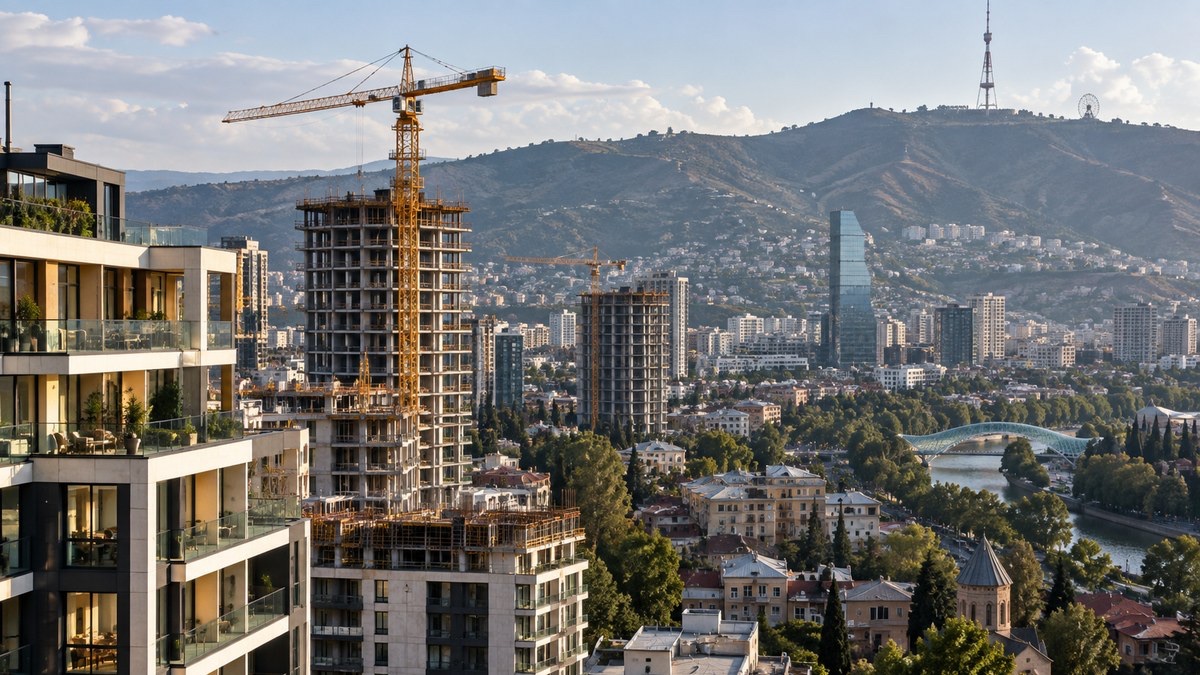
Georgia attracted $468.8 million in foreign direct investment in the second quarter of 2026, 23.2% less than in the same period of 2025, according to preliminary Geostat data released on September 8. The headline is negative, but the sector breakdown tells a more specific story for property: real estate drew $119.9 million, or 25.6% of all FDI, making it the second-largest recipient after finance and insurance.
The decline in total FDI was driven primarily by weaker reinvested earnings, Geostat said. Equity capital reached $210.5 million. Reinvestment was $300.5 million, while the sector mix remained unusually concentrated: finance and insurance received $207.6 million, real estate $119.9 million and manufacturing $59.0 million. Together, those three sectors accounted for 82.4% of the quarter’s FDI.
Property held its place despite the national slowdown
The important distinction is that sector-level FDI is not the same thing as foreign purchases of apartments. FDI can include capital injected into development companies, acquisition of corporate stakes, financing structures and other investment connected with real-estate businesses. It should not be read as a direct measure of how many homes foreigners bought.
Even with that limitation, the size of the real-estate share is material. A quarter of all foreign direct investment flowing into Georgia during the quarter was classified in real estate. That suggests property-related capital remained resilient even as the overall FDI total contracted.
The country mix was also concentrated. China was the largest investor country with $219.5 million, followed by the United Kingdom with $123.5 million and the United Arab Emirates with $47.7 million. The top three countries represented 83.3% of total FDI. Geostat’s headline release does not provide a country-by-sector matrix, so it would be wrong to assume that these national totals map directly onto the real-estate figure.
What this means for the housing market
For Georgia’s housing market, the data are more useful as a capital-flow signal than as a price signal. They say nothing directly about apartment values, transaction volumes, rental yields or the balance between primary and secondary sales. Those require separate market datasets.
What the figures do show is that real estate remains one of the main channels through which foreign capital enters the Georgian economy. If that pattern persists while total FDI remains softer, developers and large property projects may continue to compete strongly for international capital even in a less buoyant macro environment.
The next useful comparison will be whether the real-estate share remains elevated in Q3 and whether that capital translates into additional construction, completed supply or corporate transactions. For project-level comparison inside Georgia, HomeRadar can be useful for researching individual developments, while Estate Briefing continues to rely on official and institutional data for market-wide conclusions.
Data note
The Q2 figures are preliminary. FDI by economic sector is a balance-of-payments investment concept and must not be confused with residential transaction statistics or foreign-buyer counts.
Sources and limits

National Statistics Office of Georgia (Geostat) ↗
Official statistics · 2026-09-08
BM.GE ↗
Business media · 2026-09-08
This is research, not investment, tax or legal advice. Definitions and observation dates remain attached to every claim.