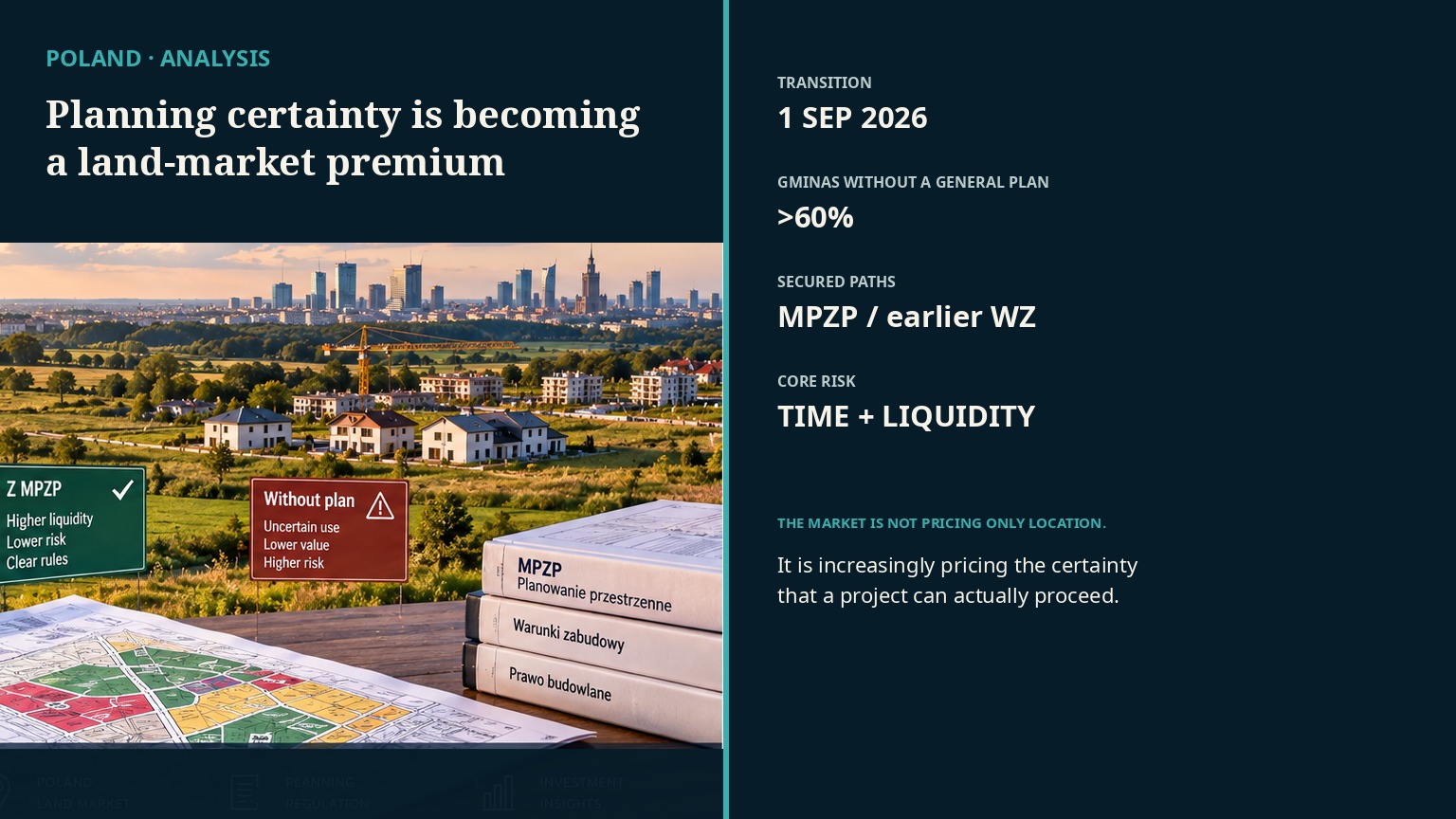
Poland's planning reform has reached the point where legal certainty is no longer a background due-diligence item. It is becoming part of the product being bought. The Ministry of Development and Technology stresses that the 31 August deadline did not invalidate existing local plans or previously issued zoning decisions, so projects already secured by those instruments can continue.
The divide appears on land that still needs a new planning route. The Polish Economic Institute reported that more than 60% of municipalities were without a general plan around the 1 September transition. In those municipalities, the ability to issue new zoning decisions or launch certain new planning procedures is constrained until the new framework is in place. That turns waiting time into a financial variable.
JLL had already warned that the reform could create a sharp polarization between plots inside and outside areas where new residential development can be supported. It also estimates that an integrated investment plan can take roughly two to three years. For a developer, that difference is not administrative trivia: it changes the cost of holding land, the timing of construction finance and the point at which a project can start generating cash.
The valuation profession is seeing the same problem from another angle. The Polish Federation of Valuers Associations has opened work on how to value property where there is no local plan, no zoning decision and no general plan in force. That is a strong sign that planning uncertainty is moving directly into valuation practice rather than remaining only a developer concern.
The market commentary published on 14 September goes one step further, arguing that plots with an MPZP, a final WZ or another secured development path are gaining relative value while land with no clear route faces a discount. Estate Briefing would treat that as a direction rather than a universal percentage premium: there is not yet a single national transaction series that isolates the price of planning certainty from location, infrastructure and permitted density.
The practical conclusion is that land comparisons now need two price tags: the price per square metre and the price of time. Poland's broader housing pipeline is still expanding, but the new planning regime can make two neighbouring plots behave like different assets if one has a bankable route to development and the other does not. See Estate Briefing's recent housing-supply briefing and Poland market guide for the wider context.
Sources and limits
Ministry of Development and Technology ↗
Official government guidance · 2026-08-31
Dziennik Ustaw / Sejm ↗
Official legislation · 2026-06-15
Polish Economic Institute ↗
Public economic research · 2026-09-10
JLL Poland ↗
Institutional market research · 2026-06-11
Polish Federation of Valuers Associations ↗
Professional guidance · 2026-09-09
Dompress / Walter Herz ↗
Property market commentary · 2026-09-14
This is research, not investment, tax or legal advice. Definitions and observation dates remain attached to every claim.