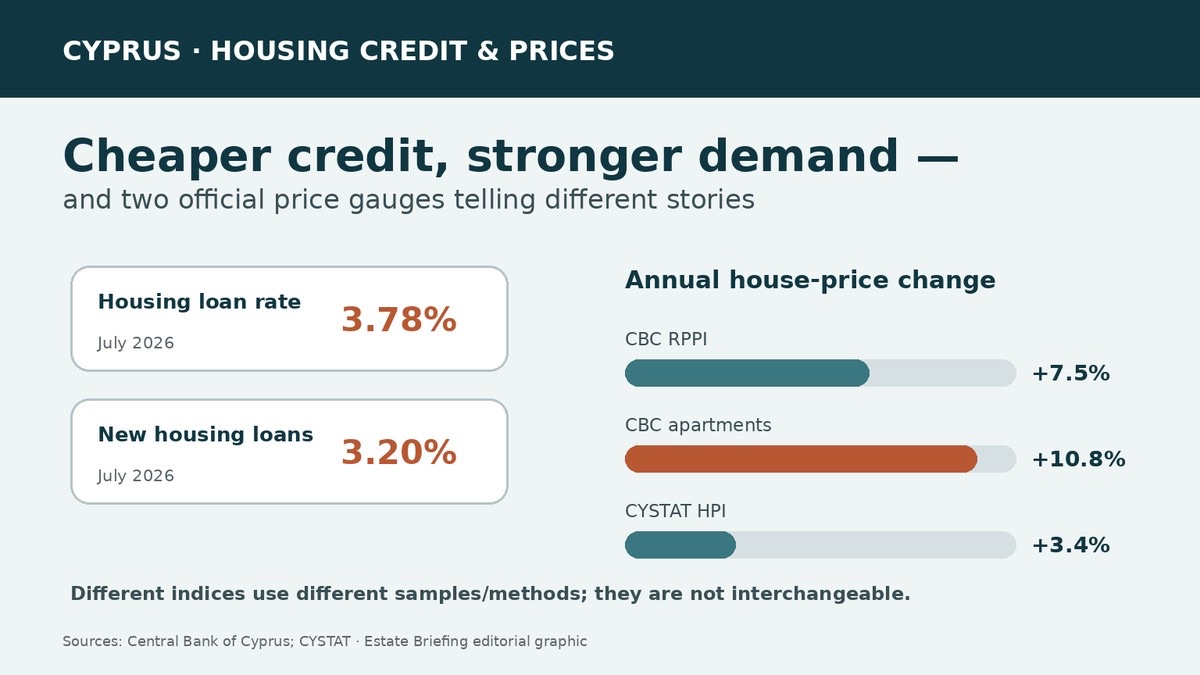
Cyprus is entering the autumn with a combination that usually supports housing demand: mortgage credit is becoming cheaper and banks are reporting stronger appetite for housing loans. Central Bank of Cyprus statistics released on 3 September put the average rate on loans for house purchase at 3.78% in July, while reporting around 3.20% for new housing lending. One day earlier, the bank's lending survey said net demand for housing loans increased in the second quarter and banks expected household loan demand to rise again in the third.
That should be supportive for transactions, but reading the price response is less straightforward than the headlines suggest. The Central Bank's Residential Property Price Index showed annual growth of 7.5% in the first quarter of 2026, with apartment prices up 10.8% and houses up 3.0%. The bank linked the rise to strong demand, particularly from foreign buyers, as well as construction costs and only gradually improving supply.
CYSTAT's official House Price Index, however, showed a much more moderate 3.4% annual increase for the same quarter. It also separated new dwellings from existing ones and recorded a 1.6% quarterly rise in the overall index.
The gap is not evidence that one institution is wrong. The two series are built from different data, samples and methodologies. The CBC index is based on property valuations connected to mortgage activity, while CYSTAT's HPI is designed as a transaction-price measure covering new and existing dwellings. When buyer mix shifts toward apartments, coastal districts or foreign-funded purchases, the indices can move at very different speeds.
That distinction matters now because the credit channel is strengthening. Cheaper mortgages can lift domestic purchasing power, while foreign demand remains much less sensitive to local mortgage pricing in some districts. A national price average therefore mixes at least two engines: local credit conditions and external capital.
The regulatory backdrop adds another layer. Estate Briefing reported on 5 September that Cyprus is considering tighter, more measurable restrictions on some non-EU property purchases. Those proposals are not final law, but they matter because the CBC itself identifies foreign demand as a major contributor to recent price growth. If the rules eventually reduce foreign participation in selected locations, the effect could be much stronger in exposed coastal segments than in Nicosia's more domestically driven market.
The practical takeaway is to avoid treating a single national percentage as “the Cyprus housing market.” The current cycle is better read through three separate lenses: borrowing costs for local households, the geography and property type of foreign demand, and the methodology of the price index being quoted. With mortgage demand rising and rates easing, domestic support is improving; whether that translates into faster transaction prices will become clearer only when later-quarter data from both official series arrive.
Sources and limits

Central Bank of Cyprus ↗
Official interest-rate statistics · 2026-09-03
Central Bank of Cyprus ↗
Official bank lending survey · 2026-09-02
Central Bank of Cyprus ↗
Official residential property price index · 2026-06-23
Statistical Service of Cyprus ↗
Official house price index · 2026-07-02
Estate Briefing ↗
Internal market context · 2026-09-05
This is research, not investment, tax or legal advice. Definitions and observation dates remain attached to every claim.