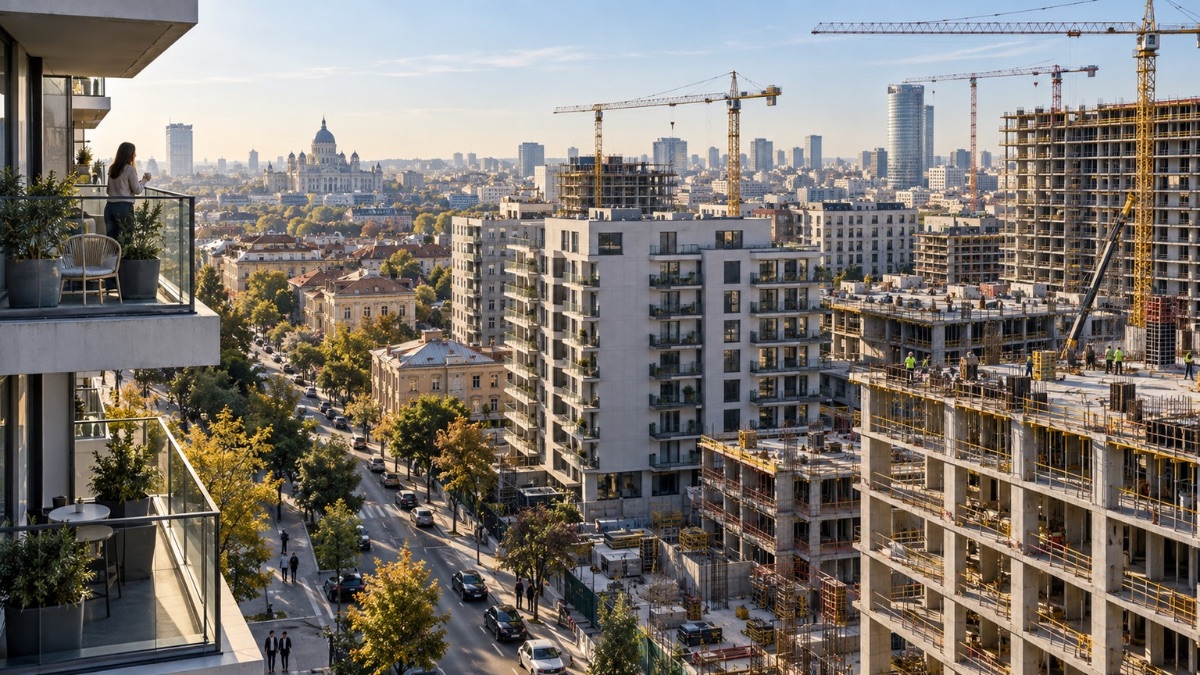
Romania’s residential slowdown is becoming a city-by-city story rather than a national correction. Colliers’ latest H1 2026 residential review puts apartment transactions down about 9% nationwide, but the spread between major cities is wide: Bucharest was roughly 2% lower year on year, Cluj-Napoca about 16% lower, Iași 11% lower, while Timișoara was around 3% higher.
That divergence matters because a national sales number can now hide very different local conditions. Cluj is still one of Romania’s most expensive housing markets, so a double-digit drop in transactions is better read as a test of affordability and buyer selectivity than proof that prices have collapsed. Bucharest, by contrast, recovered much of a weak start to the year and is entering the second half with transaction activity much closer to 2025 levels.
Supply is adding another layer. Colliers says the net residential floor area authorised in Bucharest during the first five months of 2026 was 3.6 times the level a year earlier, the strongest expansion in five years. Nationally, however, residential building permits fell roughly 9–10% in the first half, and June was about 15% lower year on year. Permits are not completed homes, but the contrast suggests Bucharest could face a more competitive new-build pipeline over the next two to five years while other cities remain more supply-constrained.
Sources and limits

Colliers Romania ↗
Institutional research · 2026-09-08
Colliers Romania ↗
Institutional research · 2026-07-15
Reddit r/cluj ↗
Public social discussion · 2026-08-22
Reddit r/cluj ↗
Public social discussion · 2026-07-15
This is research, not investment, tax or legal advice. Definitions and observation dates remain attached to every claim.